
Why We Started Lighting Smartly
Lighting is one of the few home purchases where the product listing tells you almost nothing useful. A wall sconce photographed against bare plaster looks identical whether it is hardwired into a junction box or held up with adhesive strips. A "warm white" bulb might be 2700K or 3000K, a difference you only discover after installation. A pendant advertised as "bright" may list no lumen figure at all, only a wattage number that stopped meaning anything the day LEDs replaced incandescents.
Meanwhile the questions buyers actually have are almost never answered on the product page: Will this leave holes in a wall I do not own? Does it need an electrician, or can I plug it in? Will it work with the dimmer already on my wall, or will it flicker and buzz? Can it go in a bathroom, or outside on a porch that gets rain? How often will I be recharging something? If the light is the wrong color when it arrives, can I send it back?
We started Lighting Smartly to answer exactly those questions, in the order a real buyer asks them. The premise is simple: most bad lighting purchases are not caused by bad products. They are caused by a mismatch between a fixture and a room. Our job is to surface that mismatch before you buy, not after.
Independent by Design
We are an editorial publication, not a lighting retailer or merchant storefront. We hold no inventory, process no orders and ship nothing, and we are not owned or operated by any of the brands we cover.
No manufacturer reviews our drafts, approves our conclusions, or sees an article before it is published. We do not sell placement in a "best of" list, and there is no rate card for a higher position in one. If a brand declines to answer our questions about a product, we say so in the review rather than quietly softening the coverage.
Research-Driven, and Honest About the Limits
Our work is built on manufacturer documentation, spec sheets, installation manuals, merchant listings, warranty and return policies, safety-certification records and reputable reference material on lighting practice. Where a figure is published and verifiable, we use it. Where it is not, we say the value is unknown.
We do not fill data gaps with guesses, and we do not restate a marketing adjective as though it were a measurement. "Ultra bright" is not a specification. A lumen figure is.
Affiliate-Funded, Editorially Independent
Some links on this site are affiliate links, and a purchase made through one may earn us a commission at no additional cost to you. That is how the site pays for itself. It is not how conclusions get made.
Commission rates play no part in which products are recommended, in what order they are ranked, or in how critically they are described. A product with no affiliate program at all can win a category outright. Full details are on our Affiliate Disclosure page, and the standards our writers work to are set out in our Editorial Policy.
Education Over Hype
We would rather explain a tradeoff than declare a winner. Every lighting decision has one: rechargeable convenience against recharging chores, high color accuracy against efficiency and price, a wide flood beam against a focused pool of light.
Readers who understand the tradeoff choose better than readers who are simply told what to buy, and they are far less likely to be disappointed by a product that was, technically, exactly as advertised.
The Lighting Vocabulary We Use
A large part of buying lighting badly comes down to specification terms that sound interchangeable but are not. These are the ones that decide most outcomes, and the ones you will see us return to across our reviews and guides.
Brightness: lumens, not watts
Lumens measure the light a fixture emits. Watts measure the electricity it consumes. Under incandescent bulbs the two tracked each other closely enough that "60-watt" became shorthand for a brightness level, and that habit has outlived its usefulness: a modern LED can produce the same output at roughly a tenth of the power. When a listing gives you only a wattage figure, it is telling you about the electricity bill, not the light.
Efficacy, measured in lumens produced per watt consumed, is the number that connects the two. Ordinary consumer LEDs commonly land in the region of 80 to 120 lumens per watt, with high-efficiency products going higher. Unusually low efficacy in a product claiming premium status is worth a second look.
Color temperature (CCT): the warm-to-cool axis
Correlated color temperature, measured in kelvin, describes whether light reads as warm and yellow or cool and blue. It is the single specification most likely to make an otherwise good fixture feel wrong in a room.
| Approx. CCT | How it reads | Commonly used for |
|---|---|---|
| 2200K | Amber, candle-like | Accent and mood lighting, decorative filament bulbs |
| 2700K | Warm white, closest to traditional incandescent | Bedrooms, living rooms, relaxed evening spaces |
| 3000K | Soft white, slightly cleaner than 2700K | Kitchens, bathrooms, hallways, mixed-use rooms |
| 4000K | Neutral to cool white | Task areas, worktops, garages, utility spaces |
| 5000K and above | Daylight: crisp, distinctly blue-leaning | Workshops and detail work; rarely flattering in living areas |
Two practical points follow. Mixing color temperatures within a single sightline is the most common self-inflicted lighting problem in a home: a 2700K lamp beside a 4000K ceiling fixture makes both look faulty. And "warm white" as a marketing phrase covers a range wide enough to include values that do not match each other, which is why we report the kelvin figure wherever a manufacturer publishes it.
Color rendering (CRI and R9): whether things look like themselves
The color rendering index scores, on a scale to 100, how faithfully a light source reveals color compared with a reference. Around 80 is the usual baseline for general-purpose LEDs; 90 and above is where skin tones, wood grain, food and fabric start looking genuinely natural.
The sub-score worth knowing about is R9, which covers deep reds. Many otherwise respectable CRI 80 products score poorly on it, which is why red upholstery, raw meat and warm skin tones can look strangely flat under them. Where a fixture is destined for a bathroom mirror, a dining table or a kitchen worktop, we treat color rendering as a first-tier specification rather than a footnote.
How a fixture is powered: hardwired, plug-in, or rechargeable
This is the specification that most often decides whether a product is viable for a given reader at all, and it is the one we check before anything else.
- Hardwired. Connects permanently to household wiring, normally at a junction box. Cleanest result, no visible cord, no batteries, but it requires existing wiring in the right place and, in many cases, a qualified electrician. Rules on who may perform the work and whether a permit is needed vary by jurisdiction.
- Plug-in. Runs from a standard outlet on a visible cord. Requires no electrical work, so it is broadly renter-compatible, but the cord has to go somewhere, and cord covers or swag hooks become part of the design decision rather than an afterthought.
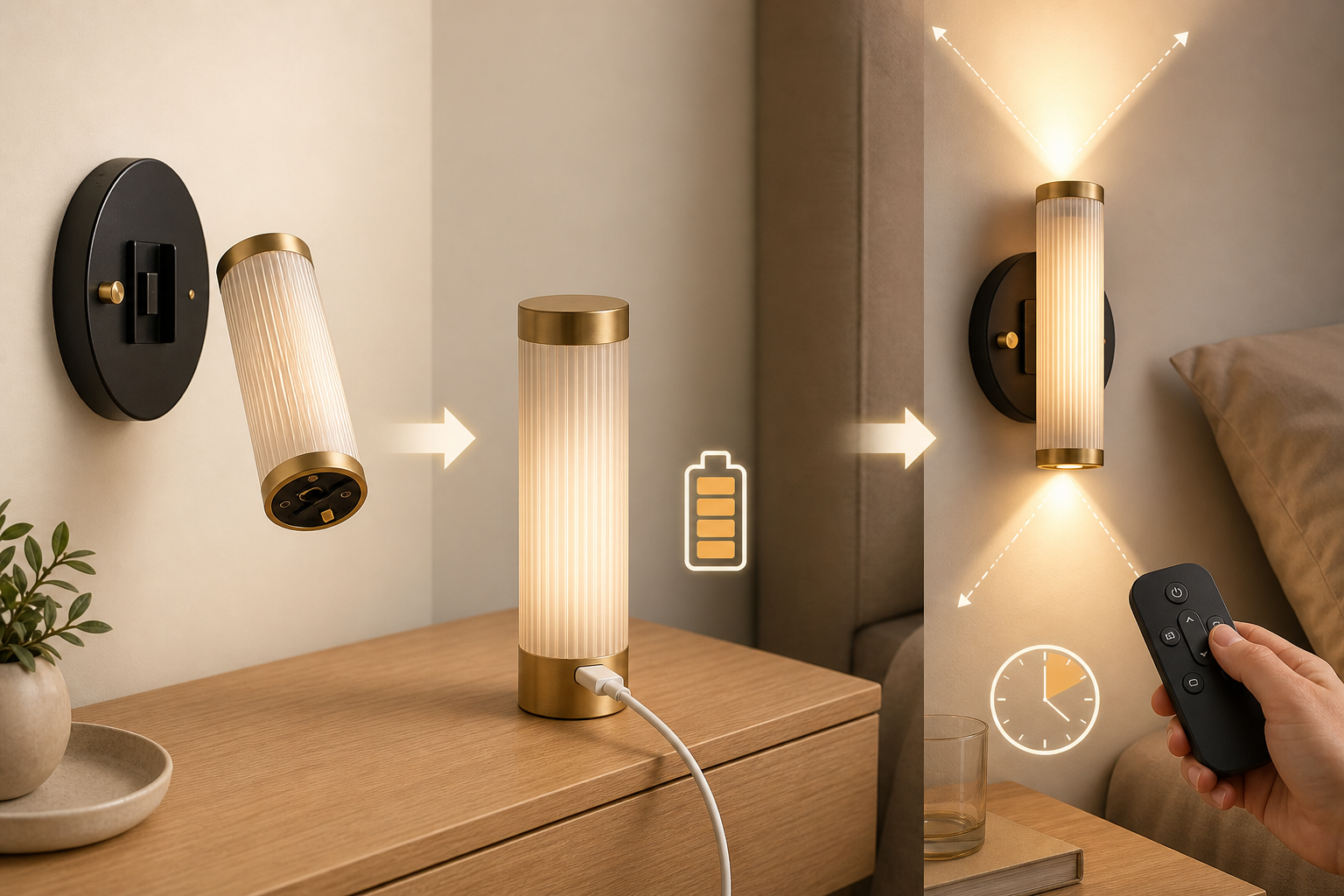
- Rechargeable or battery-powered. No wiring and no cord, which is what makes wireless sconces and puck lights so popular for rentals, closets and stairwells. The tradeoff is maintenance: runtime falls as brightness rises, batteries degrade over years of cycling, and every fixture becomes a small recurring chore. We look for stated capacity, stated runtime at a stated brightness, charging method, and whether the light can run while charging.
Dimming: the compatibility question nobody asks in time
"Dimmable" on a box means the fixture can be dimmed by something, not necessarily by the dimmer already on your wall. Wall dimmers come in different control types, many have a minimum load below which a small LED behaves erratically, and a mismatch shows up as flicker, buzzing, a dead zone at the bottom of the dial, or a lamp that will not start at low settings. Some fixtures instead dim only through their own remote, app or inline switch, and will not respond to a wall dimmer at all. We try to state which kind of dimming a product offers, because "dimmable but not with your dimmer" is a very expensive way to be technically correct.
Safety listings and location ratings
Certification marks from a nationally recognized testing laboratory, of which UL and ETL are the ones most commonly seen in the US market, indicate that a product has been tested to a recognized safety standard. Just as important is the location rating a fixture carries: dry, damp or wet. Damp-rated fixtures suit bathrooms and covered porches; wet-rated fixtures are the ones intended for direct exposure to rain or splashing.
For outdoor and bathroom lighting we also look at the IP code, where the first digit describes protection against solid objects and the second against water: IP44 covers splashing, IP65 covers water jets, IP67 covers temporary immersion. A fixture with no stated rating going into a wet location is a specification gap, and we treat it as one.
Beam angle, mounting and physical fit
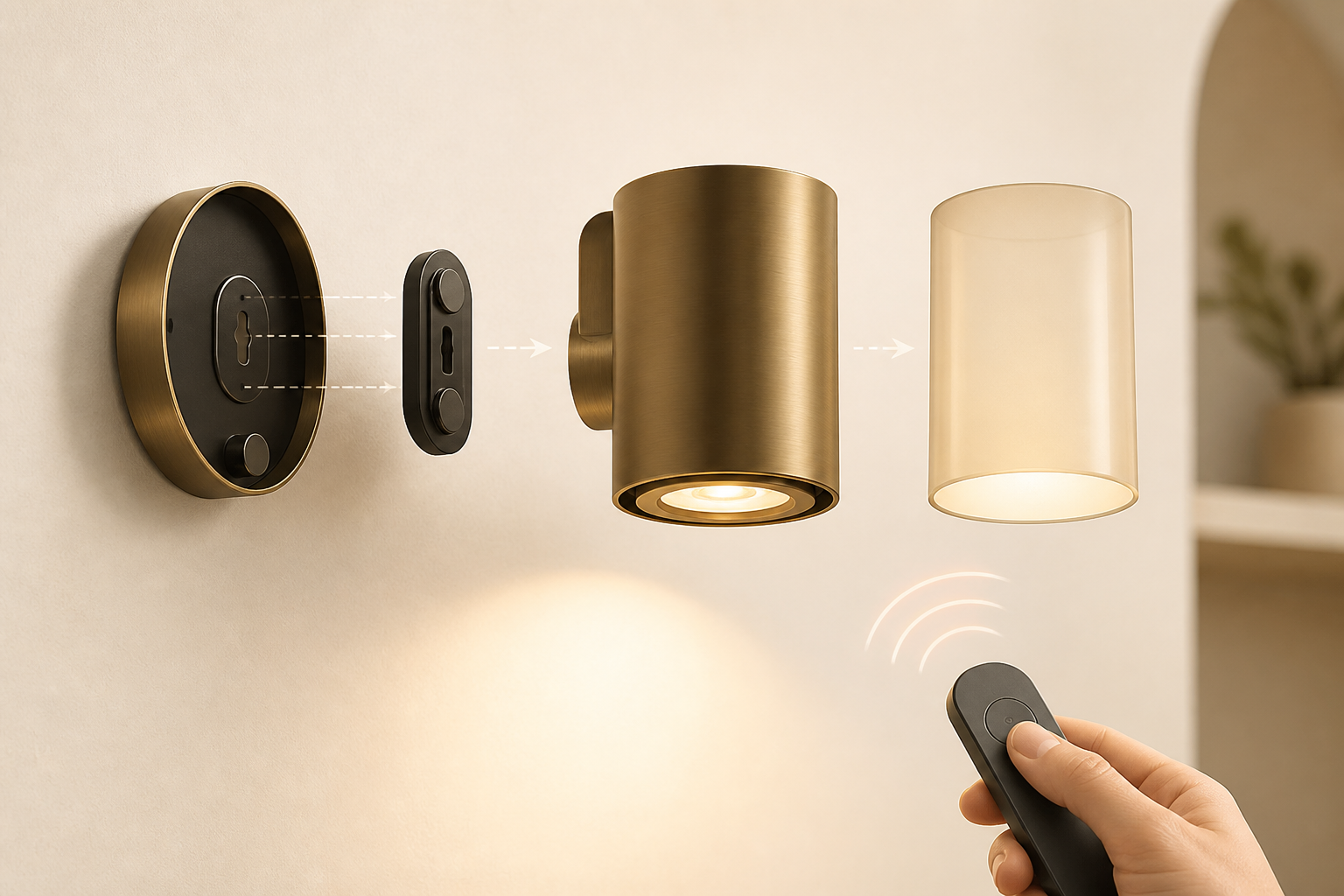
Beam angle decides whether a fixture washes a wall or spotlights a single object: narrow beams concentrate light dramatically, wide beams spread it evenly and forgivingly. Alongside it sit the unglamorous measurements that determine whether a purchase is even installable: backplate dimensions relative to an existing junction box, projection from the wall in a hallway people walk through, hanging length above a table, socket type and bulb compatibility, and whether bulbs are included, replaceable or integrated permanently. An integrated LED array that cannot be replaced makes the fixture's rated life the fixture's total lifespan, which is worth knowing before rather than after.
How We Evaluate a Light
Every product we cover is examined against the same set of questions, in roughly this order:
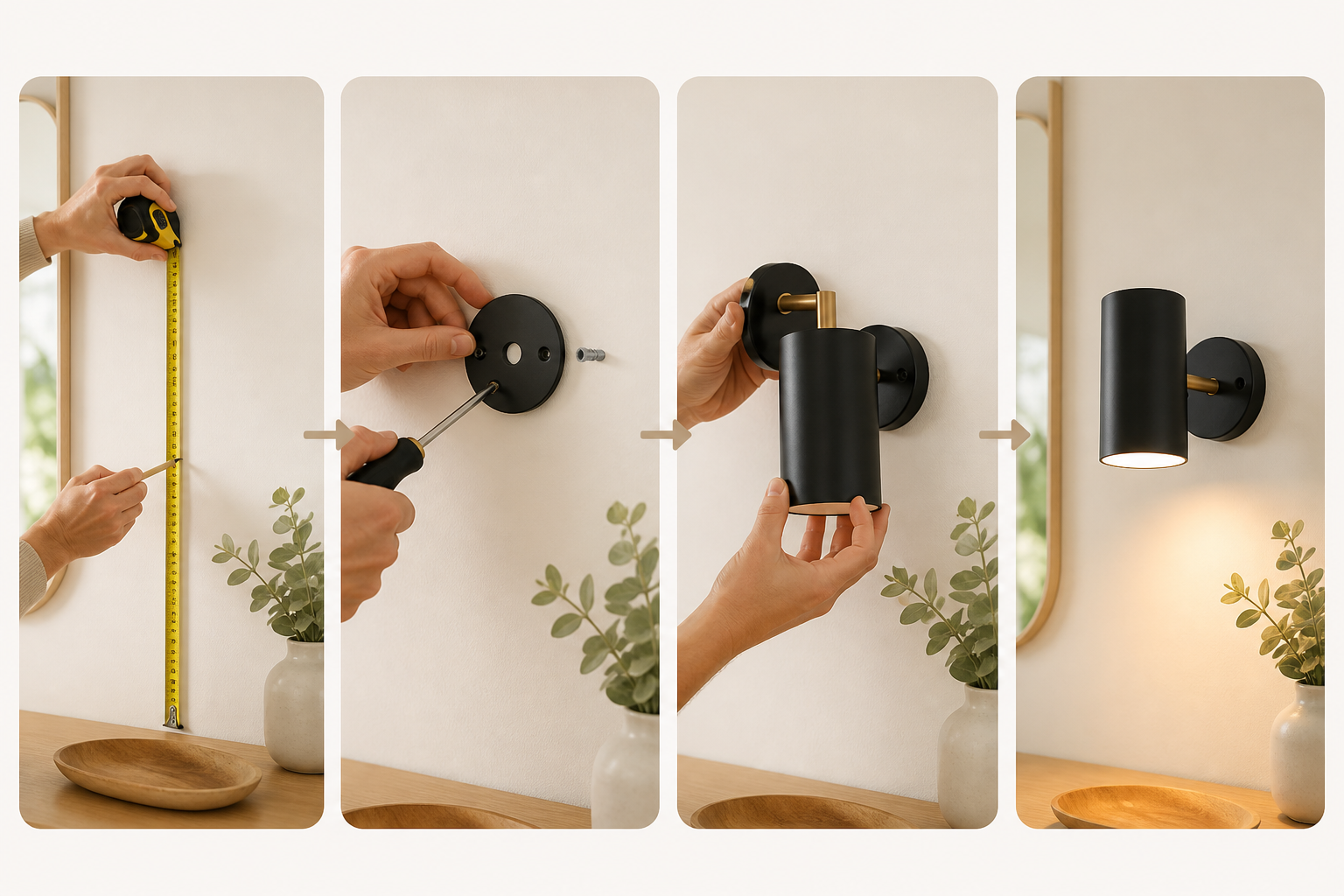
- Installation. What does mounting it actually require: wiring, drilling, adhesive, a bracket, a professional? What does it leave behind if removed?
- Power and controls. Hardwired, plug-in or rechargeable; what dims it, what switches it, and does any of that depend on an app or hub that could be discontinued?
- Light quality. Lumen output, color temperature, color rendering, beam behavior, and whether the fixture diffuses light or produces glare in normal use.
- Materials and build. Housing material, finish durability, weight relative to its mounting method, and the parts most likely to fail first.
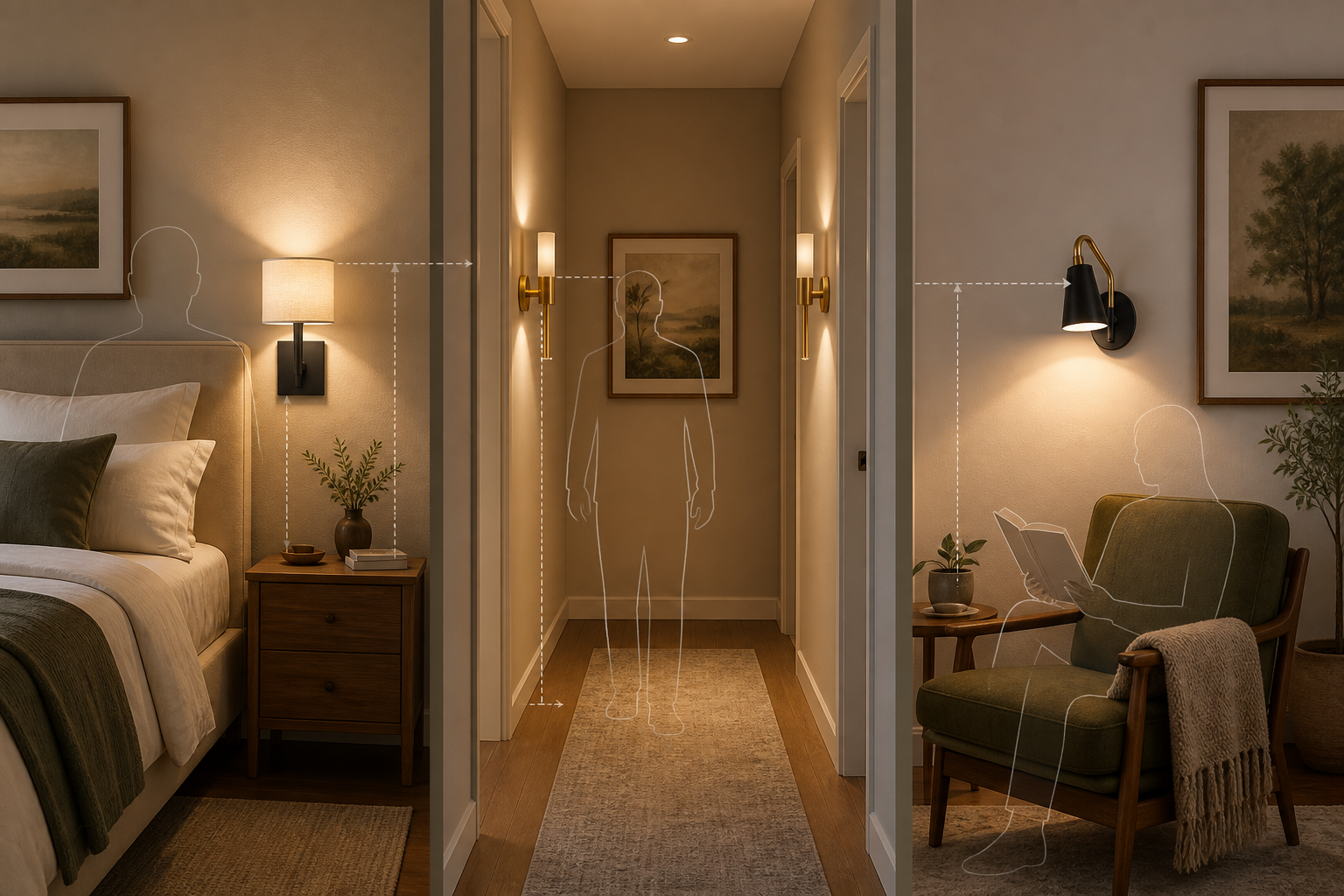
- Room suitability. Whether the rating, scale, brightness and color temperature match the room it is being sold for.
- Upkeep. Recharging cadence, bulb replaceability, cleaning access, and what happens at end of life.
- Value and merchant terms. Price against comparable alternatives, plus the return window, warranty and shipping terms that decide what happens if the product is wrong for you.
A product earns a recommendation only when there is a clear use case for it and enough verified evidence to support putting it in front of readers. "Popular" is not evidence. Neither is a high star rating on a merchant page.
Renters, Landlords and Reversible Lighting
A great deal of lighting advice quietly assumes you own the walls. We do not. A substantial share of our coverage is built around lighting that improves a space without permanent modification: rechargeable and battery-powered sconces, plug-in pendants and swag installations, adhesive and magnetic mounting, clamp and floor-standing fixtures, and bulb-level upgrades that transform an unpleasant builder-grade fixture without touching it.
For renters we pay particular attention to what a fixture leaves behind, whether screw holes, adhesive residue or damaged paint, and to whether an installation can be reversed at the end of a lease without a deposit dispute. Where a product's own instructions and a typical tenancy agreement are likely to disagree, we say so plainly.
What We Do Not Do
Being clear about our limits is part of being useful:
- We do not operate a photometric laboratory. We do not publish integrating-sphere measurements or our own lumen, CRI or flicker test data, and we do not present manufacturer figures as though we had independently measured them.
- We do not sell coverage. There is no paid placement, no sponsored ranking, and no arrangement under which a brand can buy a conclusion.
- We do not give electrical advice. We describe what an installation involves; we do not substitute for manufacturer instructions, local electrical code, or a qualified electrician.
- We do not set prices or hold stock. Merchants control pricing, availability, fulfillment, returns and warranty service independently of us, and any of those can change without notice after we publish.
- We do not invent missing specifications. An unknown value stays unknown in our coverage.
Corrections, Updates and Contact
Lighting specifications change, products are revised mid-generation, and merchants alter pricing and policies without announcement. We update material information as we become aware of it, and we welcome specific correction requests, particularly ones that point to a manufacturer document, a spec sheet or a policy page we can verify.
If you believe something on this site is wrong, tell us what the page says, what you believe the correct information is, and where that information can be confirmed. We would rather be corrected than be consistently wrong in public. Reach us through the Contact page.